
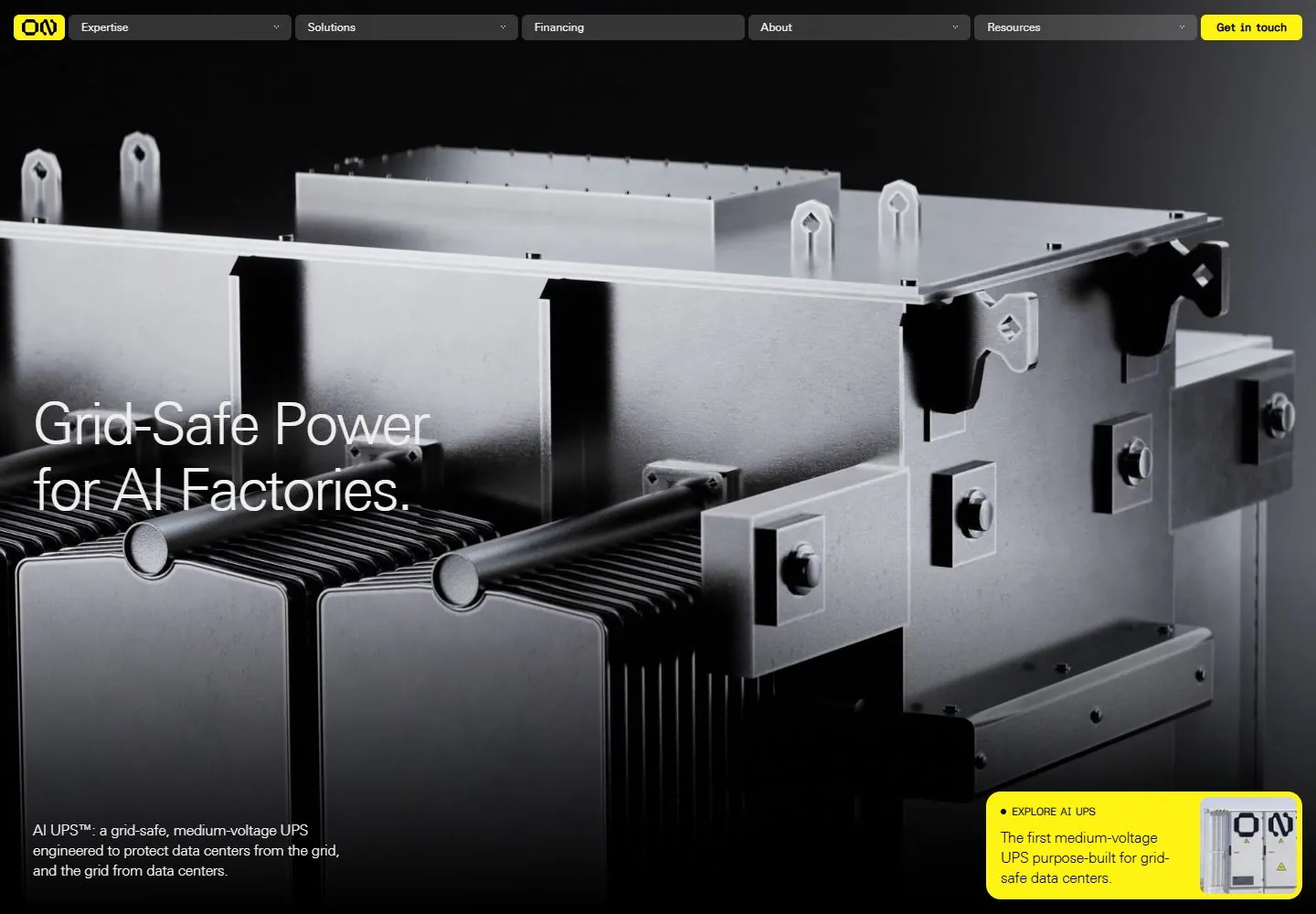
Live capture at 1440px, 2026-10-24
How it’s built
- Layout
- A monochrome industrial machine image fills the field. A thin white two-line statement sits left, small body low left and a dark translucent information card low right. Header has multiple long gray rectangular navigation segments and bright yellow identity/contact elements.
- Type
- Large light-weight sans statement, small light sans support and compact navigation. Exact font and metrics unknown.
- Color and surface
- Black/gray industrial image, white text, charcoal translucent panels and vivid yellow accents.
- Components
- Use a full-field monochrome industrial machine image behind a light white left statement, small lower-left support and dark translucent lower-right card, with segmented gray header and yellow accents.
What makes it work
- Full-field monochrome industrial machine image
- Light white left statement
- Small lower-left support and dark translucent lower-right card
- Segmented gray header and bright yellow accents
On a new subjectFor a public engineering education service, use an original monochrome machinery close-up beneath a light white left headline, small lower-left support, translucent information card and segmented gray/yellow header.
Prompts
Create a website image for {{website_name}} in {{industry}} for {{audience}}, presenting {{content}} and expressing {{functionality}}.
INVARIANTS: Use one large close-cropped illuminated physical assembly against a low-key dark stage. Place a light multi-line statement at the left, a small descriptive block lower left and one compact contrasting content/action tile lower right; shallow utility navigation runs across the top.
TYPOGRAPHY: Use light plain sans display lettering and much smaller factual labels. Keep the photographic object larger and more visually complex than the copy.
SURFACES: Near-black space, directional highlights on tactile metallic or similarly reflective material, pale type and one concentrated high-chroma utility accent. Exact yellow and gray values may change.
IMAGERY: Make an original subject-relevant physical object or assembly with readable surface detail and directional side lighting; power equipment, source marks and source product geometry are variables. Keep the image almost full-field, with a very shallow top rail and a headline around one-third of the width.
CONTINUATION: Follow with material/process or evidence content using the same small labels and restrained surface treatment. Proposed phone adaptation: simplify the top rail, deliberately crop the object to retain material/form cues, then place the headline and supporting action without overlap. Preserve the image-to-copy scale difference; no source phone behavior is inferred.
VARIABLES: Provide original identity, copy, imagery, accent color and actions for {{website_name}}, {{industry}}, {{audience}}, {{content}} and {{functionality}}.
PROHIBITIONS: Do not copy source branding, equipment design, wording or imagery. Do not add cookie overlays as style elements or infer fonts, implementation technology or tested behavior from this still. Scale targets are visual estimates, not measured shared CSS. This prompt is unvalidated.
Build a responsive website for {{website_name}} in {{industry}} for {{audience}} using {{content}} and working {{functionality}}.
INVARIANTS: Use one large close-cropped illuminated physical assembly against a low-key dark stage. Place a light multi-line statement at the left, a small descriptive block lower left and one compact contrasting content/action tile lower right; shallow utility navigation runs across the top.
TYPOGRAPHY: Use light plain sans display lettering and much smaller factual labels. Keep the photographic object larger and more visually complex than the copy.
SURFACES: Near-black space, directional highlights on tactile metallic or similarly reflective material, pale type and one concentrated high-chroma utility accent. Exact yellow and gray values may change.
IMAGERY: Make an original subject-relevant physical object or assembly with readable surface detail and directional side lighting; power equipment, source marks and source product geometry are variables. Use a dominant image plane, shallow navigation and fluid text width rather than fixed screenshot coordinates. Proposed phone adaptation: simplify the top rail, deliberately crop the object to retain material/form cues, then place the headline and supporting action without overlap. Preserve the image-to-copy scale difference; no source phone behavior is inferred.
CONTINUATION: Extend material/process or evidence content using the same small labels and restrained surfaces. Use semantic content, meaningful image descriptions, keyboard controls and visible focus. Verify headline bounds after fonts load at desktop and phone widths, and execute the actual requested actions.
VARIABLES: Provide original identity, copy, imagery, accent color and actions for {{website_name}}, {{industry}}, {{audience}}, {{content}} and {{functionality}}.
PROHIBITIONS: Do not copy source branding, equipment design, wording or imagery. Do not add cookie overlays as style elements or infer fonts, implementation technology or tested behavior from this still. Scale targets are visual estimates, not measured shared CSS. This prompt is unvalidated.
Measured
Fonts loadedUnivers Next Pro, ABC Monument Grotesk Mono
H164px / 300 / -2.56px
Body text10px
Page background#000000
Text color#eeeeee
Page height16,592px
Computed CSS at 1440px, 2026-10-24.


