
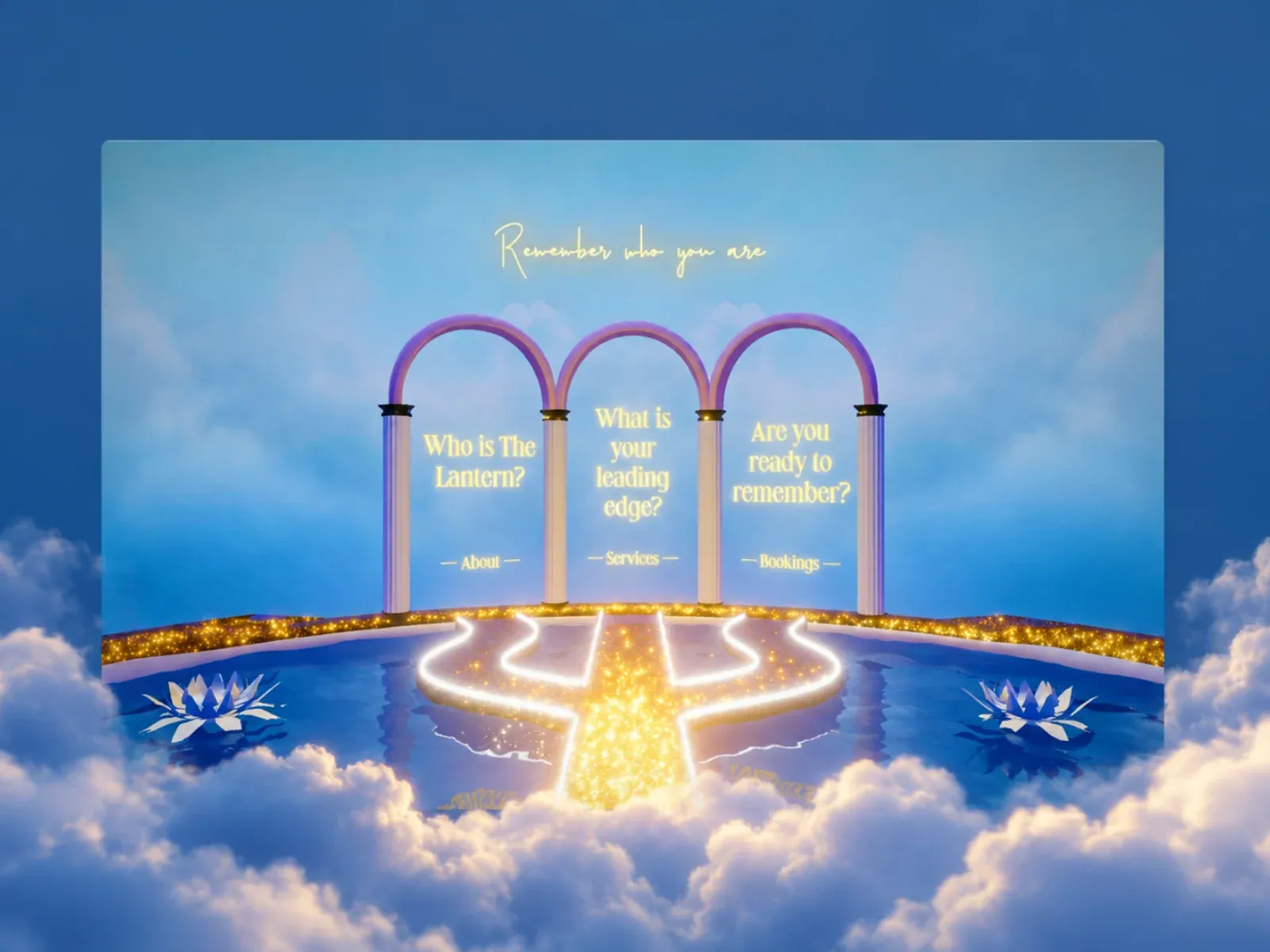
Gallery screenshot, saved 2026-10-24
How it’s built
- Layout
- Illustrated blue sky and clouds surround a centered platform with three repeated arch openings, each holding a short question and label. Handwritten sentence floats above; luminous star-shaped path converges toward foreground. Equal arch bays create choice structure while central path directs attention. Transfer short choices embedded in repeated architecture. Fantasy scene, star, words and palette are content. Animation and interaction unknown. The repeated arches supply rhythm and a stable baseline, whereas the star path breaks symmetry and pulls the eye forward. The questions are individually short enough to fit inside narrow openings; replacing them with long paragraphs would undermine this relationship. The scene uses lighting rather than borders or conventional cards to distinguish the clickable-looking regions. Gold highlights concentrate along the path and platform edge, helping navigation feel integrated into the setting. A transferable version could use repeated windows, portals, or other coherent frames, but should ensure labels remain readable against detailed illustration. The heavy cloud layer frames the central action and contributes atmosphere, rather than serving as a demonstrated reusable component. Text glow and fine strokes are visual impressions only; actual contrast and accessible behavior require separate verification.
- Type
- A thin handwritten greeting sits above three equally weighted groups of short, pale serif-like questions. Each question is centered and broken into compact lines inside its own frame; a smaller link label sits below it. The lettering has a soft luminous treatment against the illustration. Font identity, weight values and metrics are unknown.
- Color and surface
- Illustrated blue sky and cloud field with three violet/pink arch frames, pale yellow copy, and warm gold light concentrated along the platform and forward path. The arches are environmental forms, not conventional cards; no CSS surfaces are measurable.
- Components
- Three repeated arch-shaped choice regions, each pairing a question with a small link label; an introductory line above and a luminous directional path through the foreground. No standard header or buttons are visible.
What makes it work
- Give each choice equal space and typographic hierarchy
- Keep copy short enough to remain legible inside its frame
- Integrate the choice groups with one coherent illustrated environment
On a new subjectFor a science museum, place three concise exhibit questions inside three related architectural or diagrammatic frames. Introduce the set with one short prompt and use a subtle visual line to guide the eye. Choose imagery and color that belong to the exhibits, not this fantasy scene.
Prompts
Create a visual direction for {{website_name}} in {{industry}} for {{audience}}, shaping {{content}} and supporting {{functionality}}.
COMPOSITION INVARIANTS: Stage a small, depth-rich environment inside an open outer field. Use repeated vertical bays to organize short information groups, with one brighter central route or focal feature and atmospheric framing. Keep the miniature scene visually dominant; actual objects must suit the new subject. Preserve the observed visual hierarchy and spacing relationships, not the source-specific object inventory.
TYPE: Contrast a restrained, small handwritten or editorial label with compact centered display copy in each bay. Establish a clear size step from heading to choices; avoid copying the source wording or exact letterforms. Set a readable scale step between display text, supporting copy, captions, and utilities. Do not name a font family.
SURFACE AND COMPONENTS: Use a coherent limited scene palette with a light focal accent against calmer sky or ground tones. Keep light, reflection, and surrounding field distinct enough that the structure reads at a glance. Component roles: One inset environment, repeated structural bays, small top identity, concise content/actions, and a single guiding focal zone. The arches, water, clouds, and star-path are optional motifs only when relevant. Keep controls visually distinct and subordinate to the main content.
IMAGE DIRECTION: Create original miniature objects and materials with readable silhouettes and a central directional detail. Do not recreate the pictured architecture, scenery, or art. Proportion estimate from the selected still: Visual estimate: scene occupies about 85% of frame width and 75% of height; arches span roughly 45% of scene width; clouds cover the lowest 15–20%. Treat it as an estimate, not fixed CSS geometry.
VARIABLES: Adapt names, details, image subjects, palette accents, and working actions to {{website_name}}, {{industry}}, {{audience}}, {{content}}, and {{functionality}}.
PROHIBITIONS: Use original copy and assets. Do not reproduce the source brand, exact wording, photographs, illustrations, products, people, or signature artwork; source-specific objects and motifs are optional only when they genuinely fit the new subject.
CONTINUATION: Extend the environment into one subject-relevant next section using the same depth and compact label language; do not repeat the exact scene objects.
RESPONSIVE PROPOSAL: On phones, simplify scene detail and arrange the information bays as a vertical sequence below or within the scene; retain the focal route and keep labels readable. These are design proposals, not observed mobile behavior. The selected still does not establish source fonts, CSS, implementation technology, motion, or control behavior. Do not present any of those as observed. Implement requested {{functionality}} as working new behavior without implying source validation.
Implement a responsive page for {{website_name}} in {{industry}} for {{audience}}, presenting {{content}} and working {{functionality}}.
INVARIANTS: Stage a small, depth-rich environment inside an open outer field. Use repeated vertical bays to organize short information groups, with one brighter central route or focal feature and atmospheric framing. Keep the miniature scene visually dominant; actual objects must suit the new subject. Keep the same relative prominence and spacing without requiring the same source objects.
TYPE AND SURFACES: Contrast a restrained, small handwritten or editorial label with compact centered display copy in each bay. Establish a clear size step from heading to choices; avoid copying the source wording or exact letterforms. Use a coherent limited scene palette with a light focal accent against calmer sky or ground tones. Keep light, reflection, and surrounding field distinct enough that the structure reads at a glance. Maintain clear display/body/utility scale, readable line lengths, and sufficient contrast. Components: One inset environment, repeated structural bays, small top identity, concise content/actions, and a single guiding focal zone. The arches, water, clouds, and star-path are optional motifs only when relevant.
IMAGERY AND SCALE: Create original miniature objects and materials with readable silhouettes and a central directional detail. Do not recreate the pictured architecture, scenery, or art. Visual estimate only: Visual estimate: scene occupies about 85% of frame width and 75% of height; arches span roughly 45% of scene width; clouds cover the lowest 15–20%. Use flexible widths and content-led dimensions; do not copy this screenshot's coordinates as fixed values.
VARIABLES: Adapt names, details, image subjects, palette accents, and working actions to {{website_name}}, {{industry}}, {{audience}}, {{content}}, and {{functionality}}.
PROHIBITIONS: Use original copy and assets. Do not reproduce the source brand, exact wording, photographs, illustrations, products, people, or signature artwork; source-specific objects and motifs are optional only when they genuinely fit the new subject.
CONTINUATION: Extend the environment into one subject-relevant next section using the same depth and compact label language; do not repeat the exact scene objects.
RESPONSIVE PROPOSAL: On phones, simplify scene detail and arrange the information bays as a vertical sequence below or within the scene; retain the focal route and keep labels readable. Use semantic content, keyboard-operable controls, visible focus, meaningful alt text, and no clipped content. The selected still does not establish source fonts, CSS, implementation technology, motion, or control behavior. Do not present any of those as observed. Implement requested {{functionality}} as working new behavior without implying source validation.


