
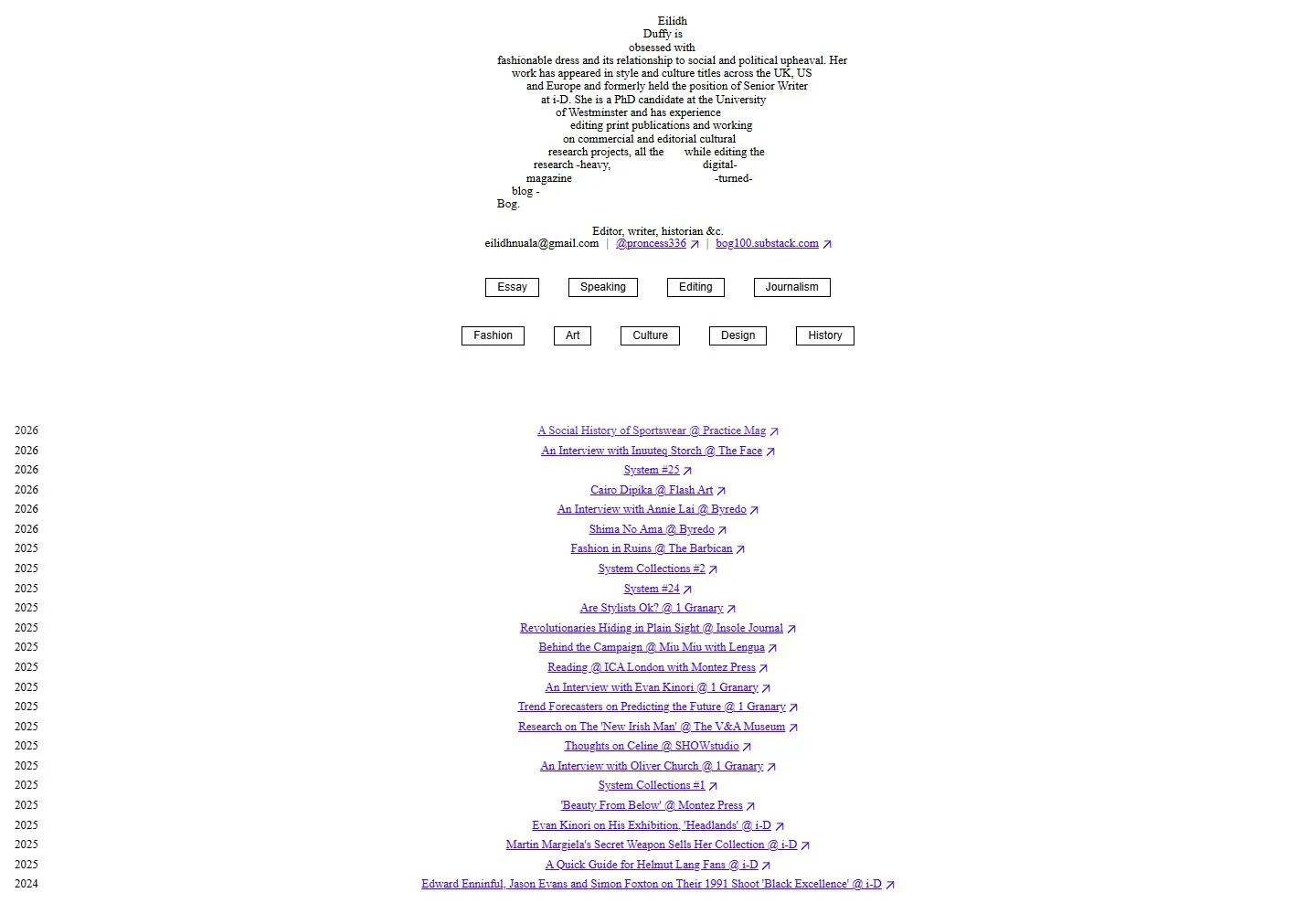
Live capture at 1440px, 2026-10-25
How it’s built
- Layout
- A white page centers a tiny serif biography and outlined category buttons above a narrow column of underlined links, with dates aligned at far left.
- Type
- Tiny black serif body, small outlined labels and underlined links.
- Color and surface
- White field with black and muted blue link text.
- Components
- A tiny centered biography and category buttons sit above a narrow link column with dates far left.
What makes it work
- White field
- Tiny centered serif biography
- Outlined category buttons and narrow underlined link column
- Dates aligned far left
On a new subjectFor a public research archive, use a tiny centered serif introduction above outlined categories and a narrow underlined publication list, with dates aligned far left on white.
Measured
H113px / 400
Body text16px
Page backgroundtransparent
Text color#000000
Page height1,000px
Computed CSS at 1440px, 2026-10-25.
Live behavior
- Today
- The Eilidh Duffy page places a narrow centered biography at the top of a mostly white canvas, with email and outbound profile links beneath it and two rows of thin outlined topic labels on desktop. A large vertical gap separates this profile block from a chronological link list: years sit in a far-left gutter while publication titles cluster around the center. At the phone width, the desktop topic-label rows are replaced in the captured frame by two compact “All” dropdowns above the links.
- Responsive
- At 1440×1000 the bio and topic labels occupy a narrow central column with wide side margins; the year labels remain at the far left while linked work titles sit toward the center. At 768×1024 the centered profile block and link list use more of the available width, while years still form a separate left column. At 390×844 the bio wraps into a narrower block, desktop topic chips are replaced by two visible “All” selects, and the link list continues below. The captures sample three widths only and do not establish exact breakpoint logic.
- Scroll
- The desktop-scroll state records actual scrollY=0 in a 1440×1000 document and matches the opening screenshot. It does not show a later section or establish scroll behavior.


